AI Visibility Tool for Dentists.
See If ChatGPT Recommends Your Practice
AskZenna tracks whether AI systems recommend your dental practice, cite your website, or name competitors when patients ask for a dentist. Based on observed responses. No estimates.
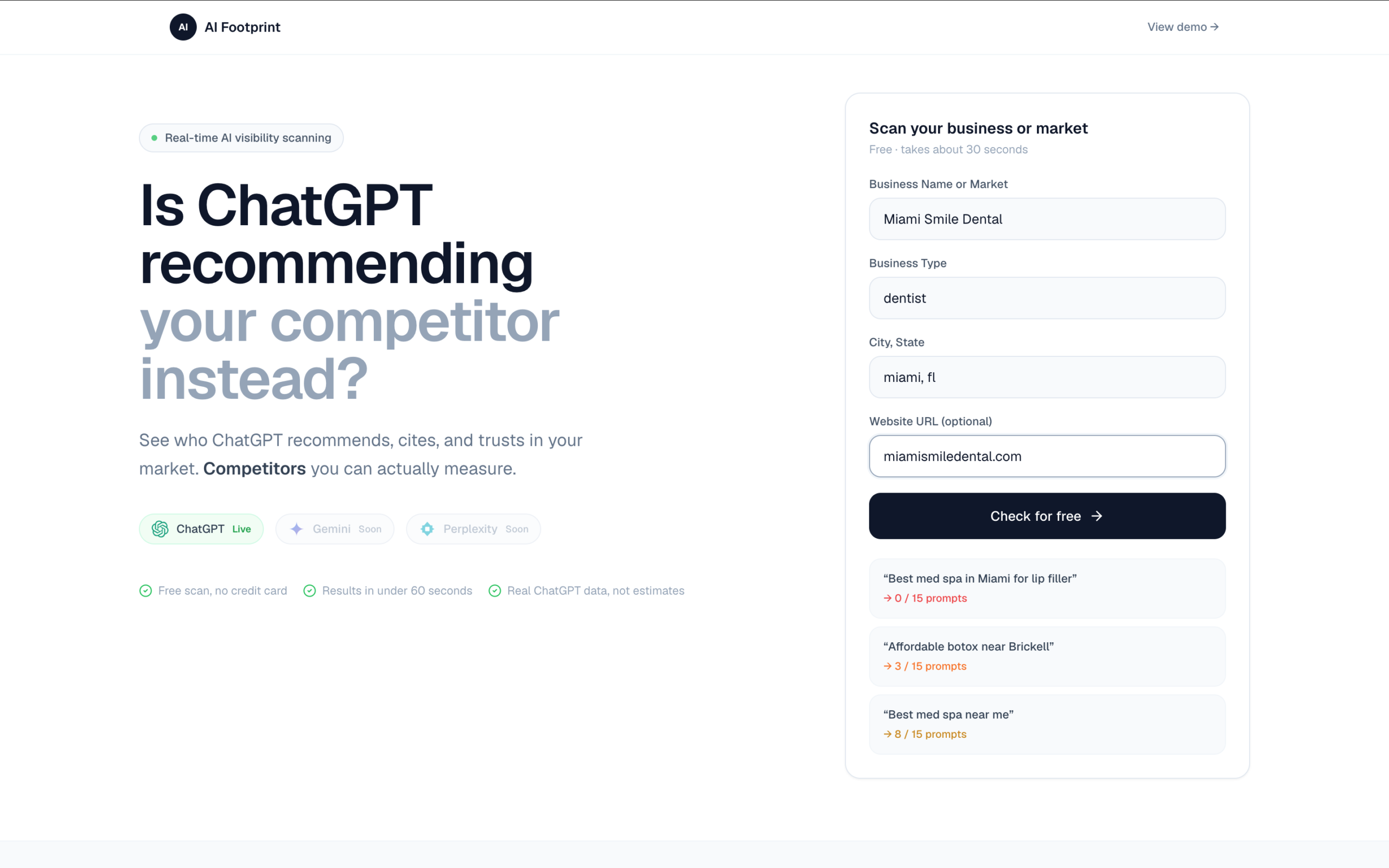
What Is an AI Visibility Tool for Dentists?
An AI visibility tool for dentists tracks how AI systems mention, recommend, and cite dental practices inside the answers they generate. It runs actual patient-style prompts through AI systems and records what came back: which dentists were named, which practices were recommended, which websites were cited, and which competitors appeared instead of your practice.
This is different from SEO. A rank tracker tells you where your website sits in Google. An AI visibility tool tells you what ChatGPT says when a patient asks for a dentist in your area. Those are two different channels, and they often produce completely different results.
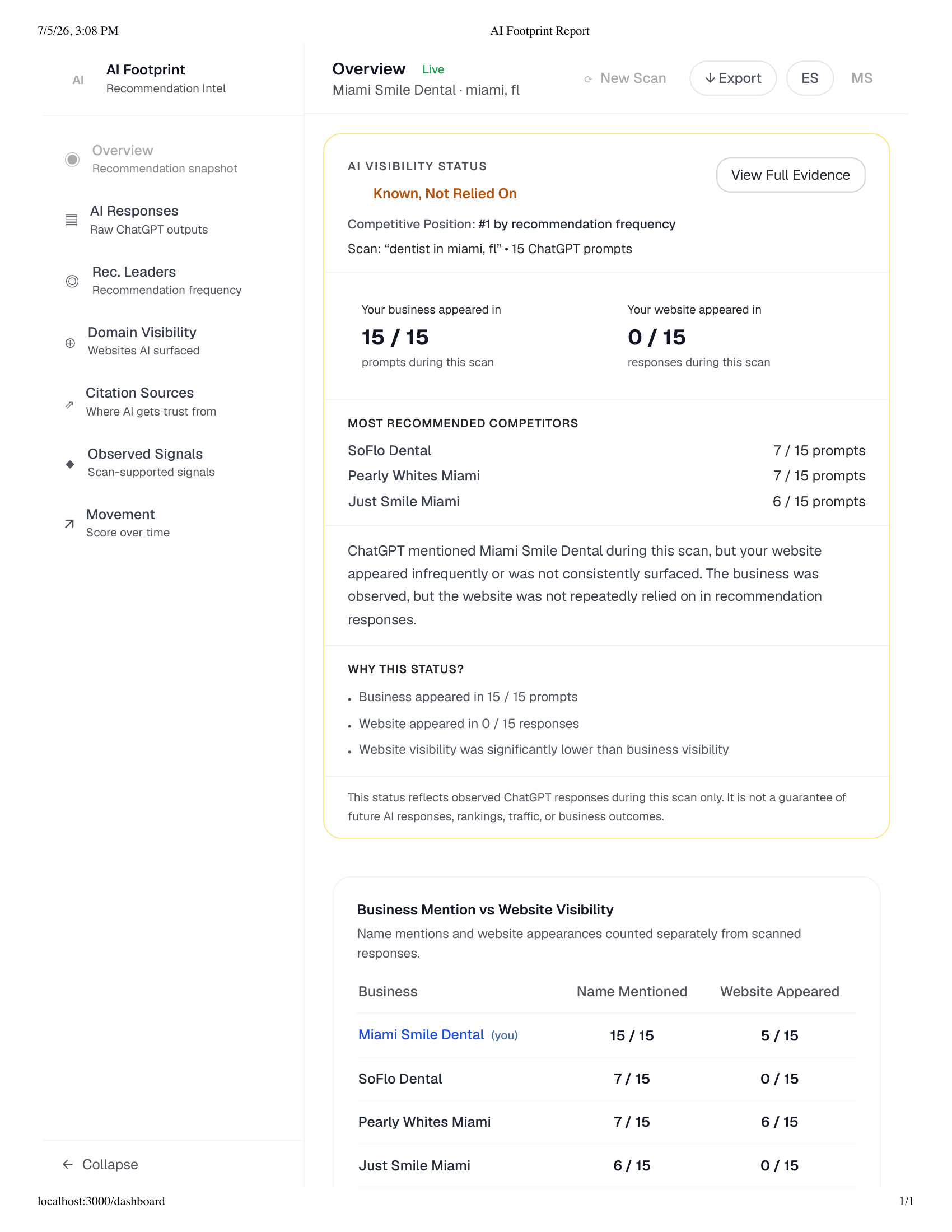
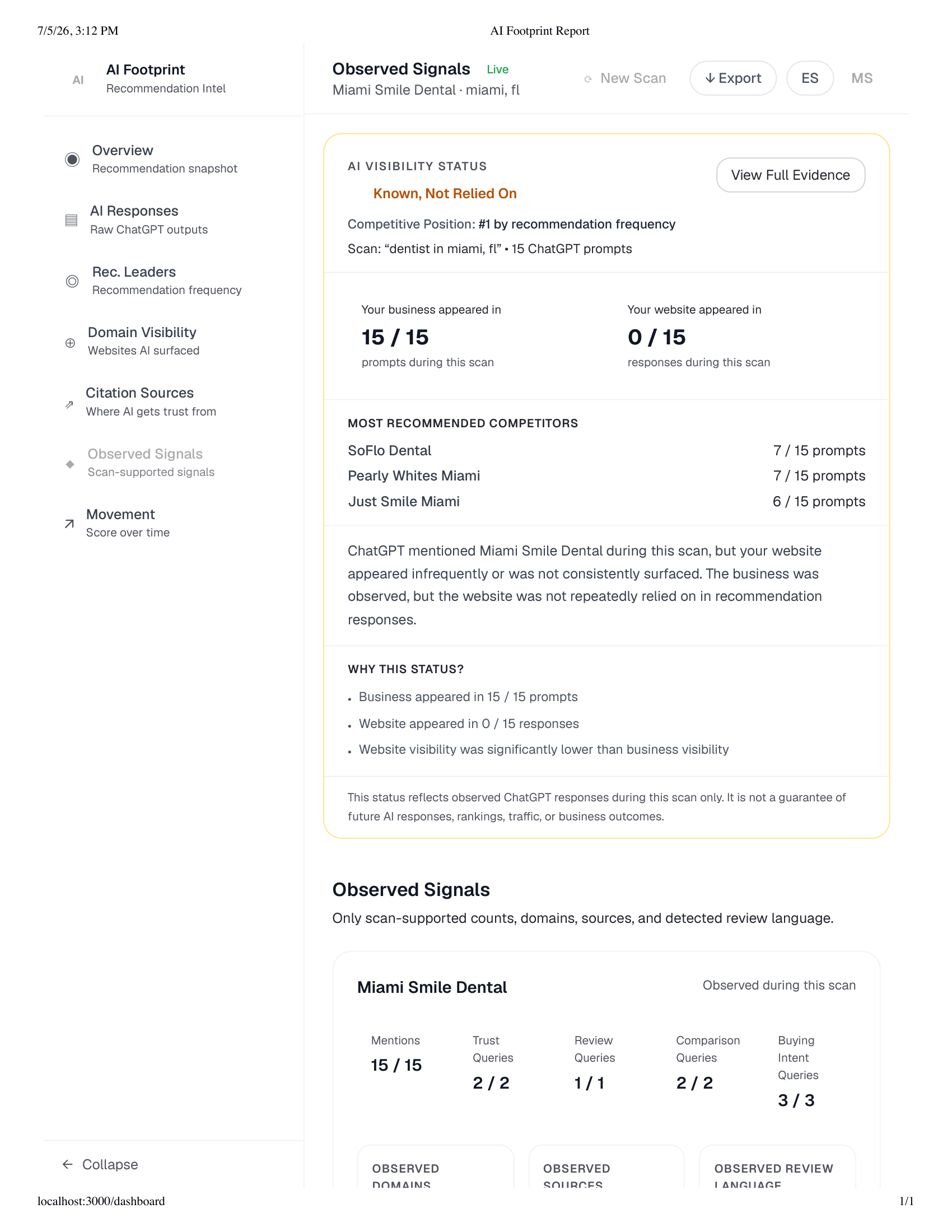
The Miami Smile Dental scan on this page is a real example. The practice ranked well. It showed up in 15 of 15 AI prompts. And yet its website never appeared once in any of the responses collected. Being named and being cited are not the same thing. The tool is built to show you both.
Everything in the scan comes from observed AI responses. No estimates. No simulated outputs. What the AI said is what the report shows.
How Patients Are Using AI To Find Dentists
Patients don’t always type a keyword into Google and scroll through results anymore. More often, they open ChatGPT, type a question, and read the answer they get back. That answer includes specific practice names.
Some of the exact prompts we run during a dental AI visibility scan look like this:
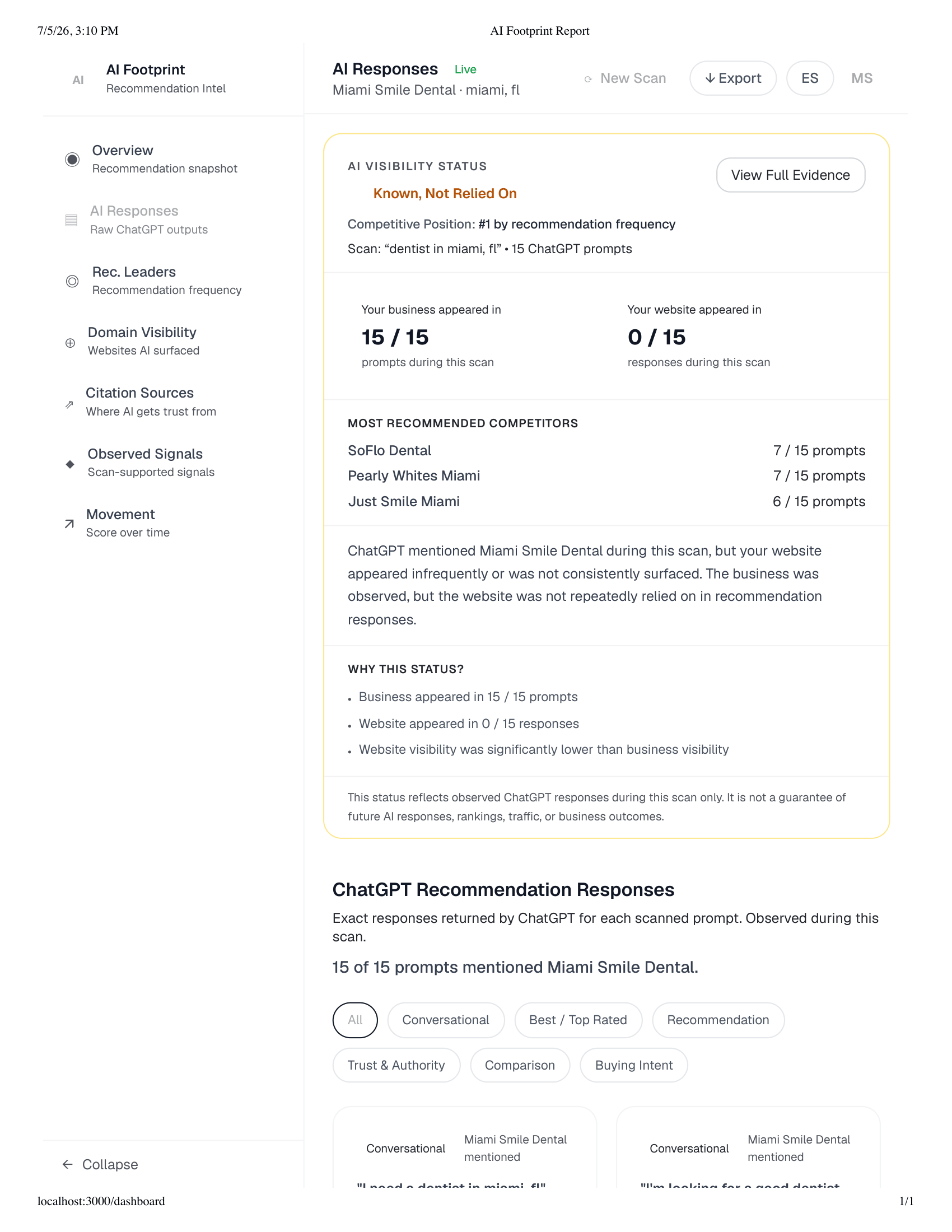
Every prompt in this scan was a variation of “dentist in Miami” asked six different ways. The keyword stays the same. The intent shifts. That matters because AI answers shift too. A conversational prompt and a buying-intent prompt about the same keyword can produce different lists of practices.
If your practice isn’t in those answers, a patient who never opens Google may never know you exist. And if a competitor shows up consistently while you don’t, they’re capturing attention at a moment your current tools can’t see.
The same scan can be run for Invisalign in Miami, dental implants in Miami, cosmetic dentistry in Miami, or any other service you want to map. Each keyword tells a different story. A practice that leads in “dentist in Miami” responses may not lead in “Invisalign Miami” responses. Running scans across your core services gives you a full picture of where your practice stands in AI recommendations, service by service, so you can see the gaps and decide where to focus.
What the Miami Dentist Scan Revealed
We ran a dental AI visibility scan on Miami Smile Dental, a practice that ranks #1 in Google for “dentist in Miami.” We chose it specifically because of that ranking. A Google leader is the strongest test case for showing whether traditional search performance and AI recommendation visibility line up. We sent 15 prompts to ChatGPT, all variations of “dentist in Miami,” spread across six prompt types: Conversational, Best / Top Rated, Recommendation, Trust & Authority, Comparison, and Buying Intent. AskZenna has no business relationship with Miami Smile Dental. This scan was conducted independently for demonstration purposes.
Here’s what the data showed across four dimensions.
Known, Not Relied On
Miami Smile Dental appeared in every single AI response collected during the scan. Fifteen prompts, fifteen mentions. By recommendation frequency, the practice was ranked first in its market.
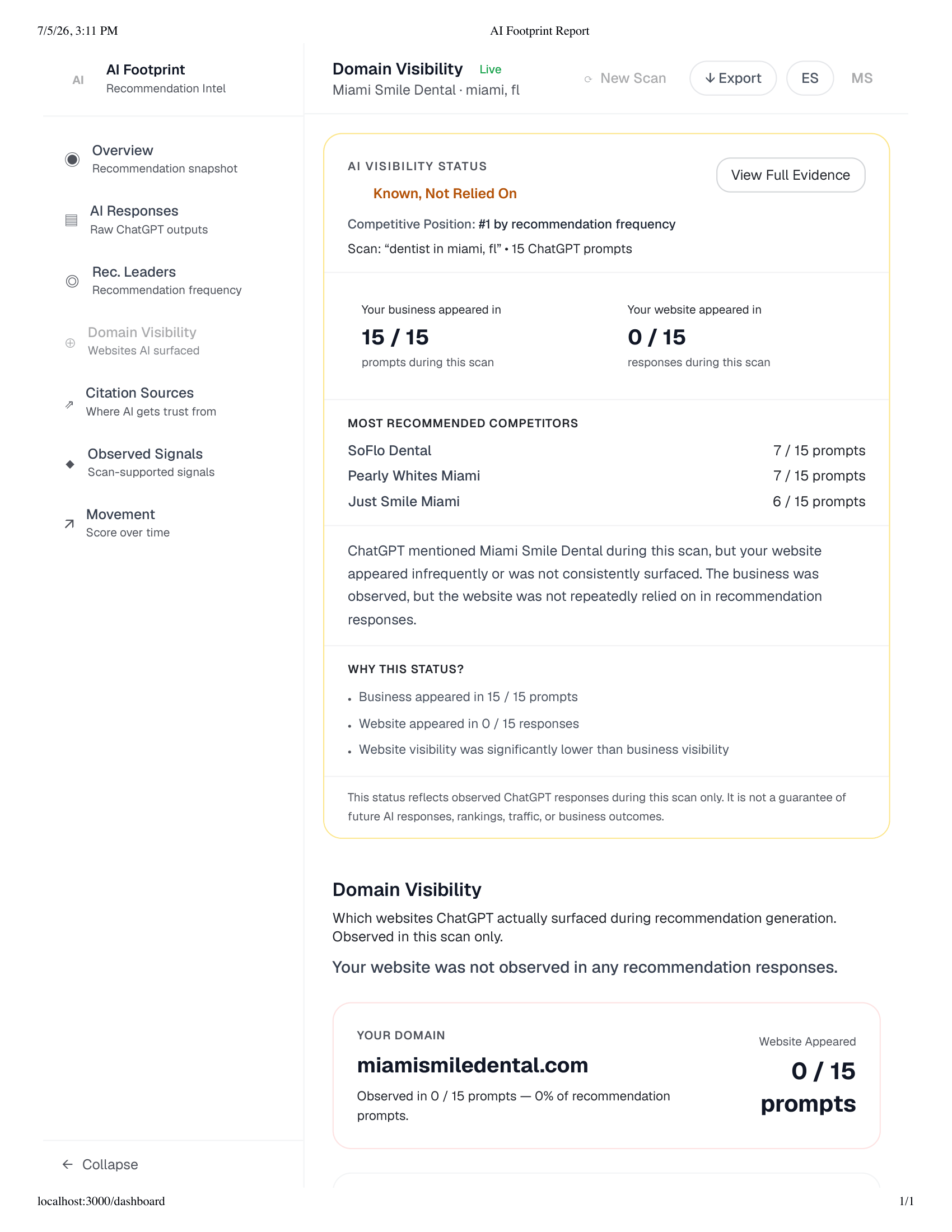
Its website appeared zero times.
That’s the “Known, Not Relied On” pattern. AI systems recognized the practice as a credible recommendation, but when forming answers, they weren’t drawing from its website as a source. Competitors with fewer name mentions still had their websites cited. That’s a different kind of presence, and in some ways it’s a stronger one.
Being mentioned by name is visibility. Having your website cited is authority. The scan shows you both numbers separately, so you can see exactly which kind of AI presence your practice has right now.
Known. Not Relied On.
What Dentists Can Learn From AI Recommendation Data
AI visibility data for dental practices breaks down into several layers. Each one tells a different part of the story.
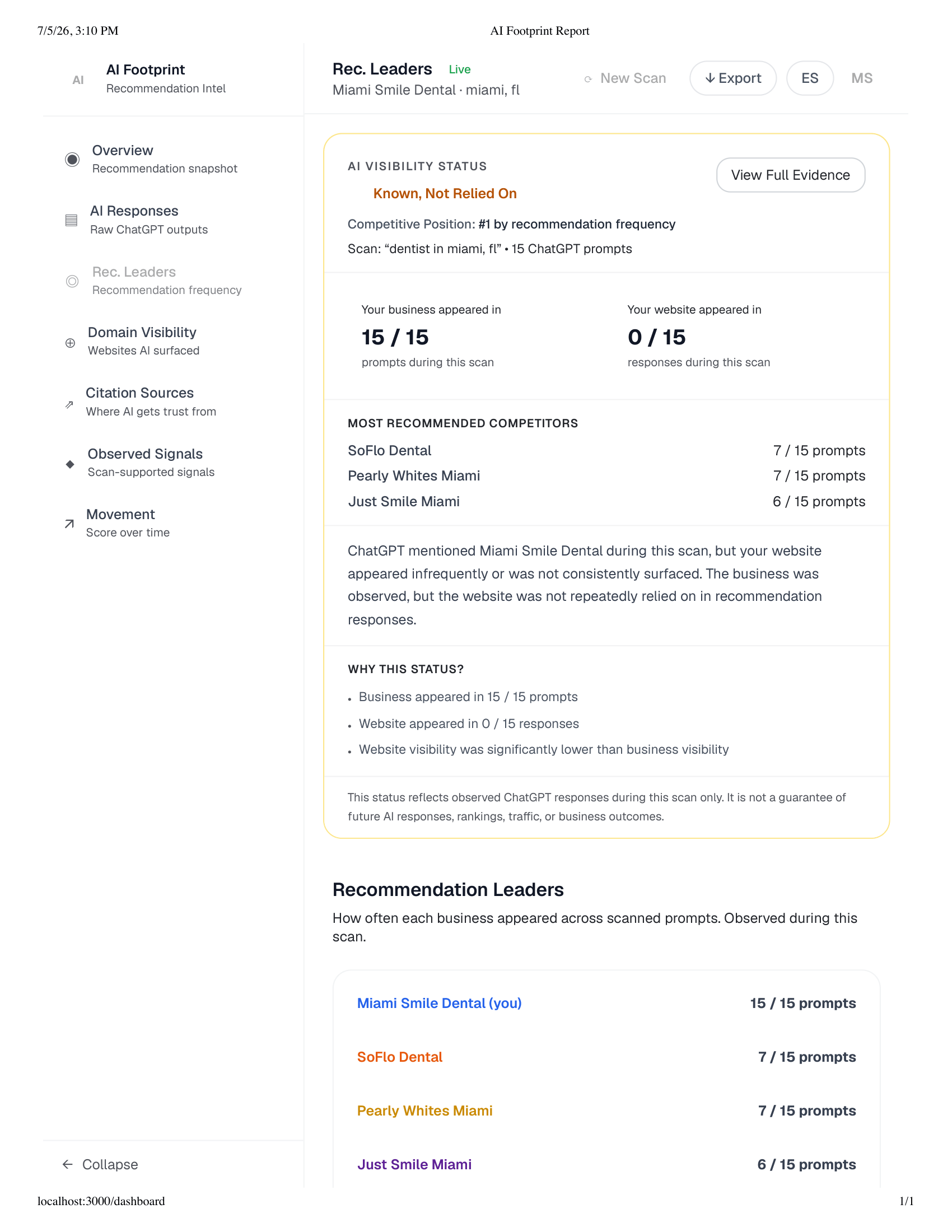
Recommendation frequency shows how often your practice name appeared across all prompts. Miami Smile Dental scored 15/15. That number matters because it tells you whether AI recognizes your practice as a credible recommendation in your market.
Competitor frequency shows how often each other practice appeared in the same responses. In the Miami scan, SoFlo Dental and Pearly Whites Miami each appeared in 7 of 15. Knowing which competitors AI recommends, and how often, is context you can’t get anywhere else.
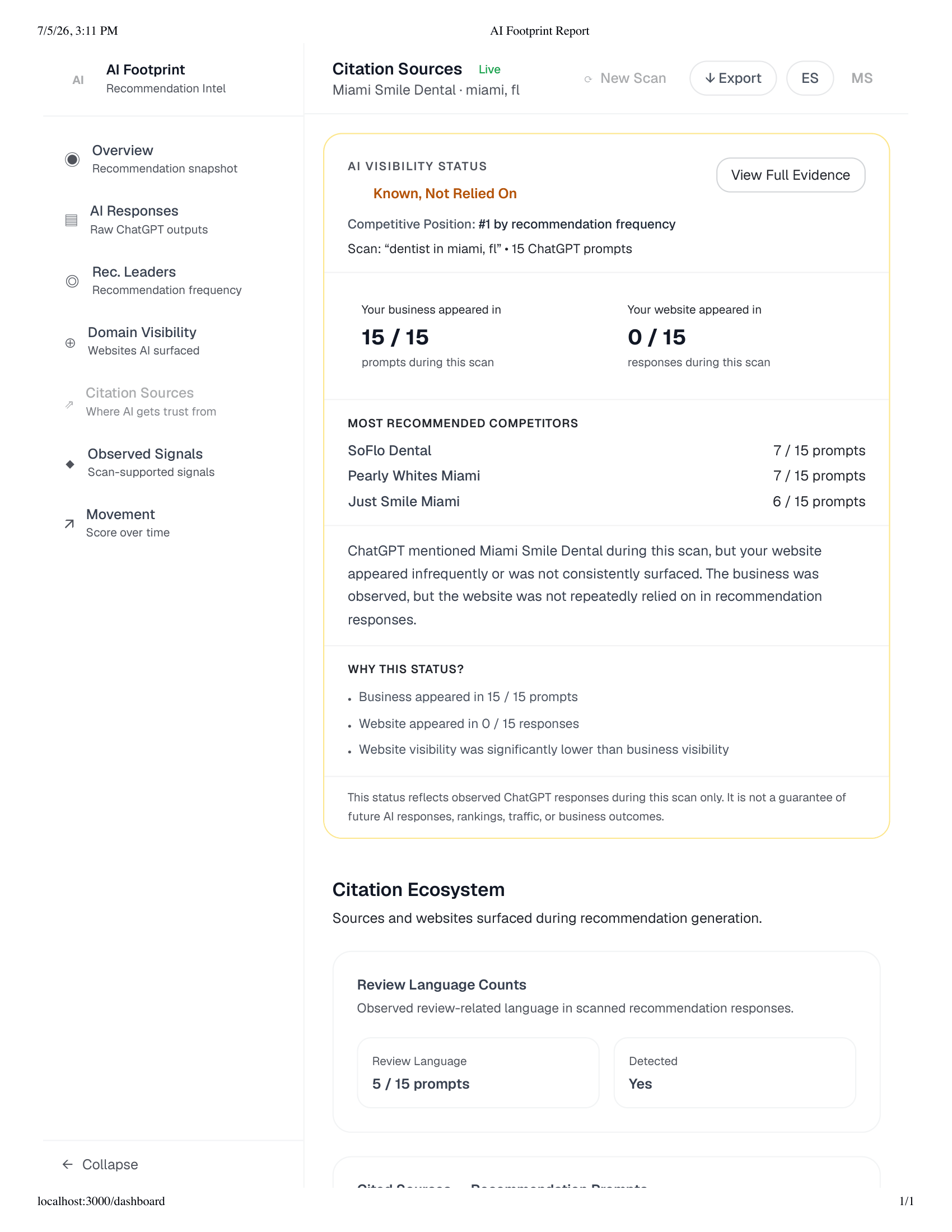
Citation frequency shows which practice websites AI drew from when forming answers. This is separate from name mentions. A website that AI cites as a source has a different kind of authority in that answer than a name that simply comes up.
Prompt-type visibility shows whether your practice appeared across all six prompt categories: Conversational, Best / Top Rated, Recommendation, Trust & Authority, Comparison, and Buying Intent. Those last three are the prompts closest to a patient making a decision. Miami Smile Dental appeared across all prompt types, which is why its overall mention count reached 15 of 15.
Prompt-level visibility shows the full breakdown prompt by prompt, so you can see exactly which question types triggered your practice to appear and which didn’t.
What You Can See Inside the AI Visibility Tool
The report is where the tool turns raw AI responses into readable dental visibility intelligence. Concrete counts. Actual responses. No interpretive layer between you and the data.
AI Visibility Tool vs Traditional Dental SEO Tools
Dental SEO tools measure keyword rankings, local pack positions, and website traffic. They’re good at what they measure.
They don’t measure what ChatGPT says when a patient asks which dental practice to choose in your city. That requires a different tool collecting different data from a different channel.
AskZenna doesn’t replace your dental marketing stack. It shows you the part of the patient journey your current tools can’t see.
| Dimension | Traditional Dental SEO Tool | AskZenna AI Visibility Tool |
|---|---|---|
| Best for | Tracking keyword rankings, local pack positions, and website traffic. | Tracking whether AI systems recommend, mention, and cite dental practices in generated answers. |
| Channel | Google search results and local pack | AI-generated recommendation responses |
| Data source | Crawl data, keyword data, review signals | Observed AI responses collected during the scan |
| Competitor view | Keyword overlap and local ranking gaps | Which dental practices AI recommended and how often |
| Output | Rankings, traffic estimates, review counts | Practice mentions, competitor appearances, website citations |
| Blind spot | Cannot show what ChatGPT says when a patient asks for a dentist recommendation. | Does not replace local SEO, rank tracking, or Google Business Profile management. |
Both tools answer valid questions about your dental practice. They just answer different ones.
Built for Every Type of Dental Practice
If patients in your specialty ask AI for a recommendation before booking, there’s something worth tracking. The scan works across all dental practice types.
If patients ask AI for a recommendation in your dental specialty, there’s something to track.
Based on Responses. Not Estimates.
Every number in an AskZenna dental AI visibility report comes directly from AI responses collected during the scan. There’s no modeling layer. No algorithm that infers what ChatGPT probably thinks about your practice. What came back is what the report shows.
The Miami Smile Dental example on this page is a real scan. The 15/15 mention count is a real count. The 0/15 website citation count is a real count. The competitor appearance data reflects actual responses that were collected and parsed.
No projected visibility scores. No simulated results. No dental SEO estimates applied to AI data.
AI answers change over time. They vary based on how questions are phrased and which system answers them. Every scan is a point-in-time view of observed responses. If you want to track how your dental practice’s AI visibility changes, that requires running multiple scans over time.
Why I Built This
I wanted to know whether AI systems were recommending my businesses or someone else’s.
SEO tools showed me rankings. Analytics showed me traffic. But nothing showed me what AI was saying when someone asked for a recommendation in my market.
AskZenna started as a way to answer that question. The Miami dentist scan on this page is exactly the kind of thing it was built to surface: a practice that appears constantly in AI answers but has zero website citations. That’s a real finding. You can’t see it with any tool that only looks at Google.
That is why AskZenna exists: to make AI recommendations, citations, and competitor visibility measurable.
Does ChatGPT Recommend
Your Dental Practice?
Your current marketing tools don’t show what AI says when patients ask for a dentist. AskZenna does. Based on observed responses. No estimates.
Common Questions from Dental Practices
Yes. ChatGPT actively names dental practices when patients ask recommendation questions. Whether your practice appears in those answers, and how often, depends on how AI systems have learned about your practice from public sources.
AskZenna runs real prompts and records what comes back. The Miami Smile Dental scan on this page is a real example: the practice appeared in 15 of 15 prompts. The scan shows you exactly where your practice stands based on collected responses.
The only reliable way is to run a scan using actual patient-style prompts and collect the responses. Guessing based on your Google rankings or your website traffic won’t show you what ChatGPT says when someone asks for a dentist in your area.
AskZenna submits targeted prompts covering your dental specialty and market, collects the AI responses, and structures what came back into a readable report. Request a free scan to see your results.
The scan shows you exactly how often each competitor appeared compared to your practice. You’ll see their mention counts, citation counts, and which prompt types triggered their name.
AskZenna can’t change what AI says, and it doesn’t make any promises about influencing AI recommendation frequency. What it can do is show you the competitive landscape as it exists in AI responses right now, so you’re working from real data instead of assumptions.
No. Name mentions and website citations are two different things. The Miami Smile Dental scan is the clearest example of this: the practice appeared in every single AI response while its website appeared in none of them.
AI can recommend a dental practice by name without using that practice’s website as a source. The scan tracks both counts separately so you can see exactly what kind of AI presence your practice has.
Yes. Each scan targets one keyword across six prompt types. The Miami scan on this page used “dentist in Miami” as the keyword. An Invisalign scan would use “Invisalign in Miami” or “Invisalign provider in [city]” the same way — asked conversationally, as a best-of query, as a recommendation, as a trust query, as a comparison, and as a buying-intent question.
Running separate scans for Invisalign, dental implants, cosmetic dentistry, and general dentistry gives you a service-by-service map of where your practice stands in AI recommendations. A practice that leads in one keyword may be absent in another. That’s exactly the kind of gap worth knowing before you put a plan together.
Yes. Multi-location dental groups and DSOs use AskZenna to track AI recommendation visibility across multiple markets. Each location scan is treated independently since AI recommendation patterns vary significantly by city and geographic area.
If you’re managing multiple locations, mention that when you request a scan and we’ll work through the scope with you.
No. Dental SEO measures keyword rankings, local pack performance, and organic search traffic in Google. AskZenna measures whether AI systems recommend your dental practice, cite your website, and name competitors inside AI-generated answers.
They measure different channels. A dental practice can rank strongly in Google while being absent from AI recommendation answers, or appear in every AI response while its website is never cited. The Miami Smile Dental scan on this page is an example of the second scenario.
Yes. Agencies that work with dental practices use AskZenna to run AI visibility audits for client markets, benchmark how client practices appear against competitors in AI-generated answers, and add AI recommendation data to their reporting.
Mention agency use when you request a scan so we can discuss scope and how the reports are delivered.
The AI visibility tool runs against real AI responses from your dental market. You’ll see exactly what came back.
Request Your Free Dental AI Visibility ScanNo software to install. Scan requests reviewed before delivery.
AskZenna AI visibility reports reflect observed AI responses collected during the scan period. AI outputs vary based on how questions are phrased, when they’re asked, and which AI system answers them. Results represent a point-in-time view only. AskZenna does not control, influence, or guarantee the outputs of any AI system. No metric in any AskZenna report is estimated, simulated, or projected. The Miami Smile Dental scan shown on this page was conducted independently by AskZenna for educational and demonstration purposes only. AskZenna has no business relationship with Miami Smile Dental, is not affiliated with Miami Smile Dental in any way, and was not commissioned or authorized by Miami Smile Dental to conduct this scan or publish these findings. Miami Smile Dental was selected as a scan subject solely because it ranks prominently in Google search results for “dentist in Miami,” making it a relevant example for illustrating the difference between search engine visibility and AI recommendation visibility. All data shown reflects AI responses observed at the time the scan was conducted and may not reflect current AI outputs.