AI Visibility Tool.
Track Who AI Recommends, Cites, and Trusts
AskZenna is an AI visibility tool that shows how your business appears inside AI-generated answers. Track recommendations, competitor mentions, website citations, and observed response patterns across your market.
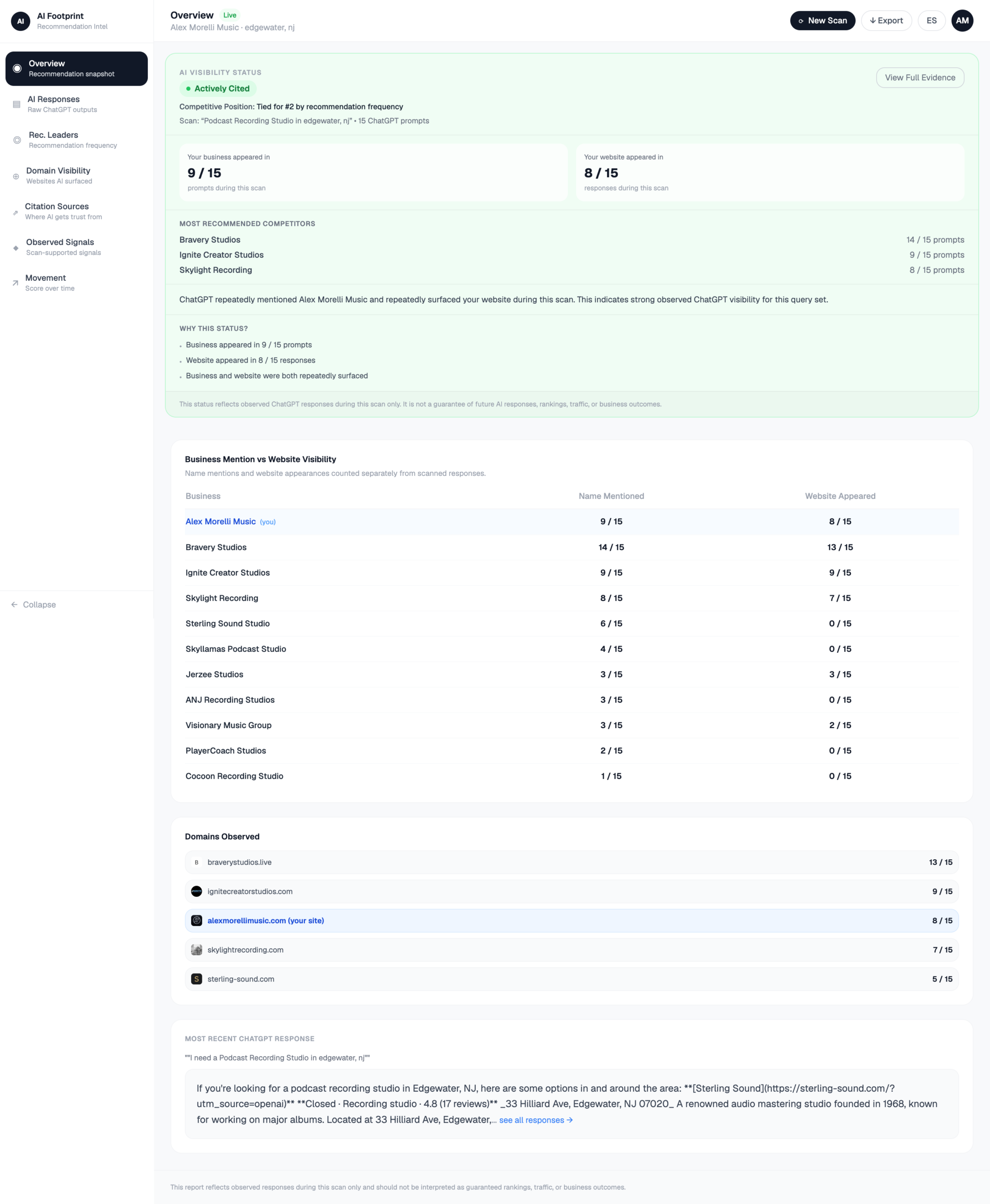
What Is an AI Visibility Tool?
An AI visibility tool helps businesses monitor how AI systems mention, recommend, compare, and cite brands inside generated answers. That’s a different question from where you rank in Google. It’s about what ChatGPT, Gemini, Perplexity, and other AI systems say when someone asks for a recommendation in your category.
A checker gives you a snapshot. A tool helps you monitor patterns over time. AskZenna is built to do both: run a scan against real prompts, collect the responses, and structure what came back into readable visibility intelligence.
What the tool tracks: AI search visibility across prompt types, ChatGPT visibility and competitor mentions, domain citations counted separately from name mentions, and prompt-level visibility showing which questions triggered your business to appear and which didn’t.
Everything in the scan comes from observed responses. No estimates. No projections. What AI said is what the report shows.
Why Businesses Need an AI Visibility Tool Now
Customers are no longer only searching Google. They’re asking ChatGPT which dentist to call. They’re asking Gemini which HVAC company covers their area. They’re getting recommendation lists from Perplexity and AI Overviews before they ever click a result.
If your competitors appear in those answers and you don’t, your business is invisible in a discovery channel your current SEO tools don’t measure. A rank tracker tells you nothing about what ChatGPT says when someone asks for a recommendation. Neither does your analytics platform.
This isn’t a future problem. AI-generated recommendations are active right now across local services, professional categories, and buyer-intent queries. Someone is asking which attorney to hire, which med spa to book, which roofing company to call. In markets where one competitor shows up in 14 of 15 answers, the others don’t get a chance to compete.
Your current marketing stack shows you what happened on your website. It doesn’t show you what AI is saying before people decide whether to visit it.
AskZenna shows you that. It’s an AI visibility tool built specifically to surface the channel your existing tools can’t see.
People Are Asking AI. Most Businesses Have No Idea What It Said.
Ask your customers how they found you lately. More often than you’d expect, the answer involves AI. Someone asked ChatGPT which service to use. Someone asked Perplexity to compare providers in their area. Someone got a recommendation list and picked from it.
That’s a real channel. It’s active right now. And for most businesses, it’s completely invisible.
You can track rankings. You can track traffic, leads, ad performance, reviews. What you probably can’t track is whether AI systems are naming your competitors instead of you every time someone asks for a recommendation in your category.
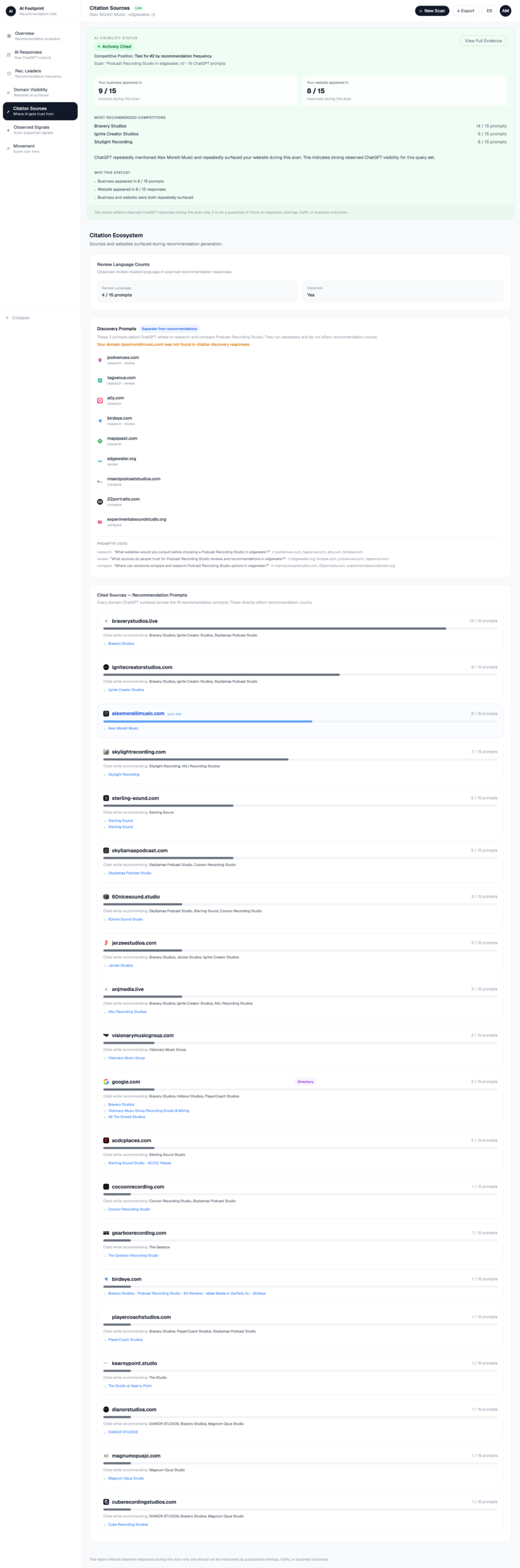
That’s not a hypothetical concern. Take the scan above. Bravery Studios appeared in 14 out of 15 questions about recording studios in Edgewater, NJ. One competitor. 14 of 15 answers. That kind of concentration is common. And most businesses in that market have no idea it’s happening.
The question isn’t whether AI is recommending businesses in your category. It almost certainly is. The question is who’s showing up.
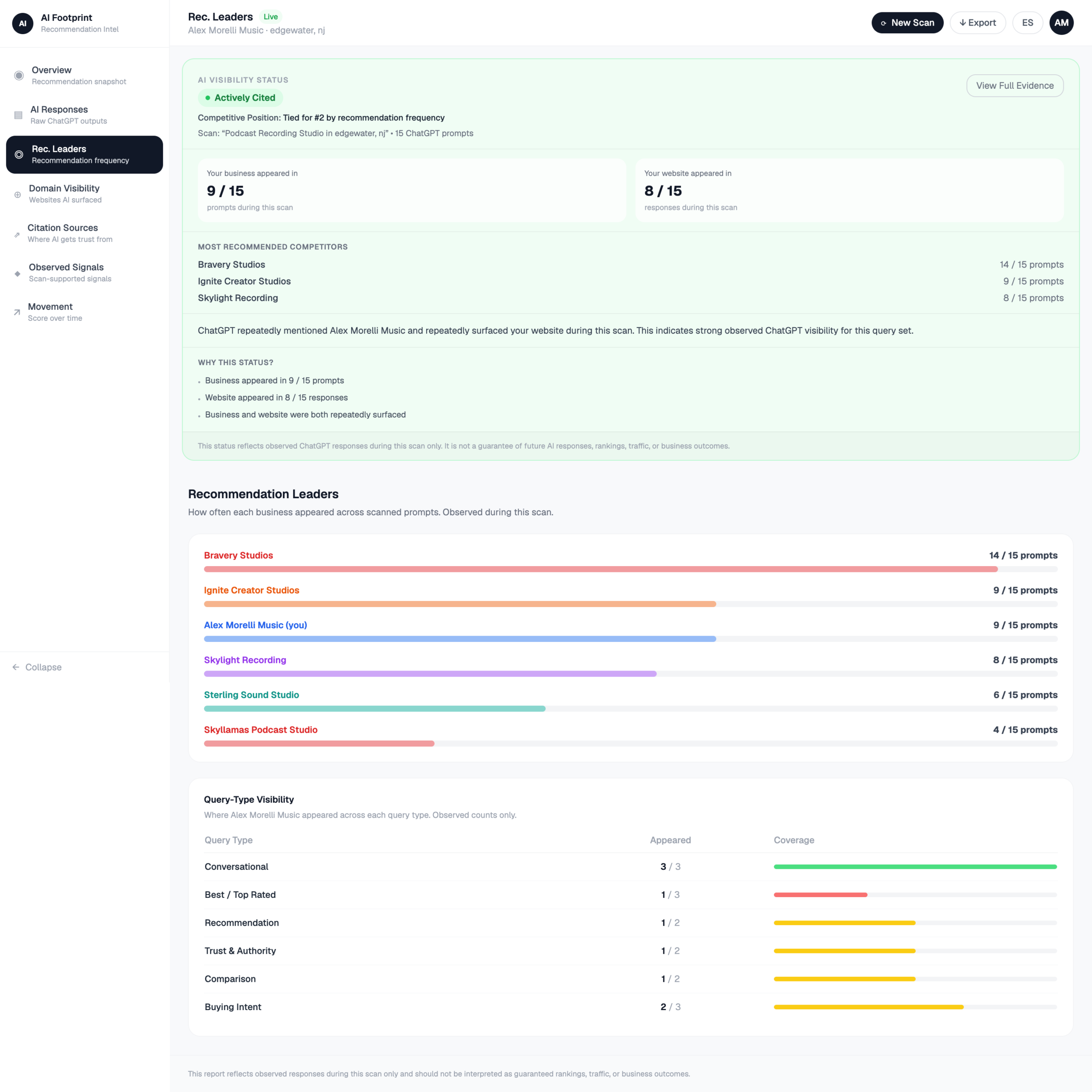
What the AskZenna AI Visibility Tool Tracks
The tool collects real AI responses and pulls specific data from them. Here’s what’s tracked in every scan.
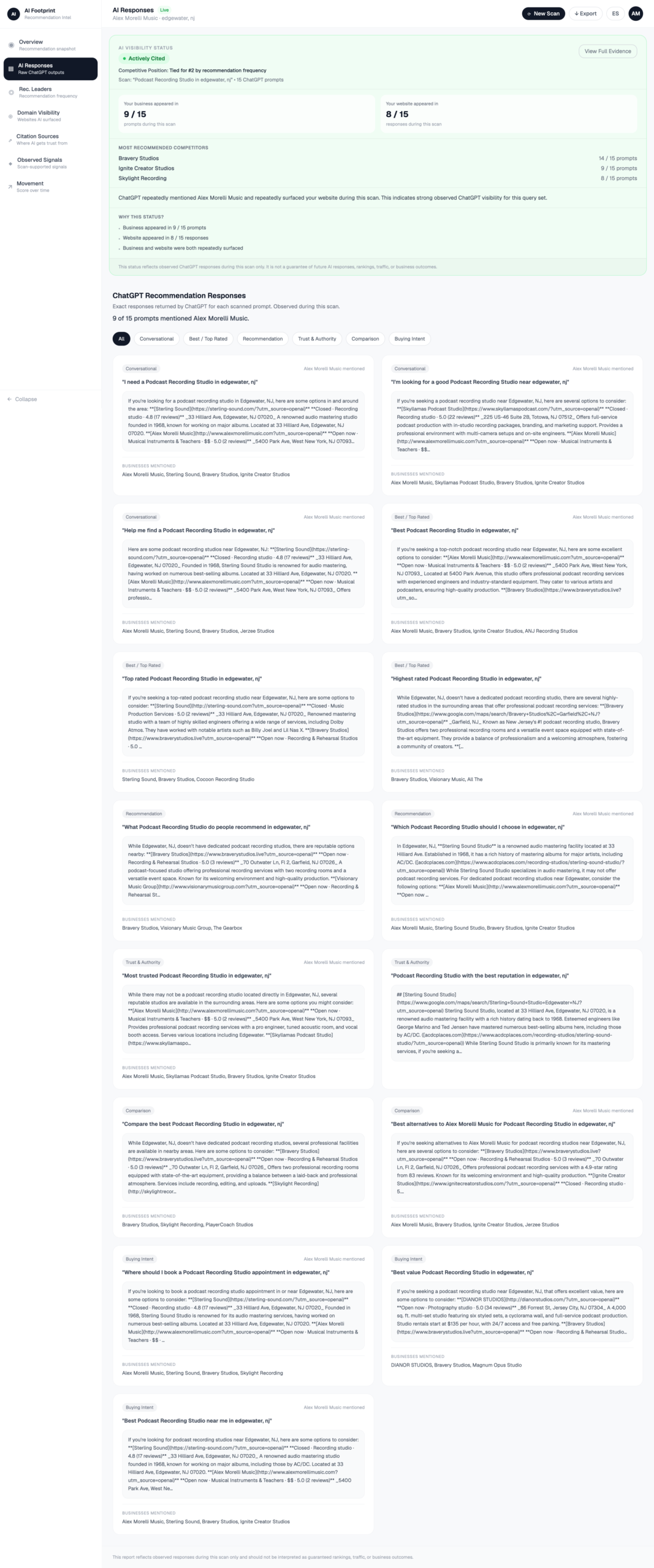
Getting Named Is Not the Same As Getting Your Website Cited
AI can recommend your business by name without ever linking to or citing your website. Those are two different kinds of AI visibility. The tool separates them.
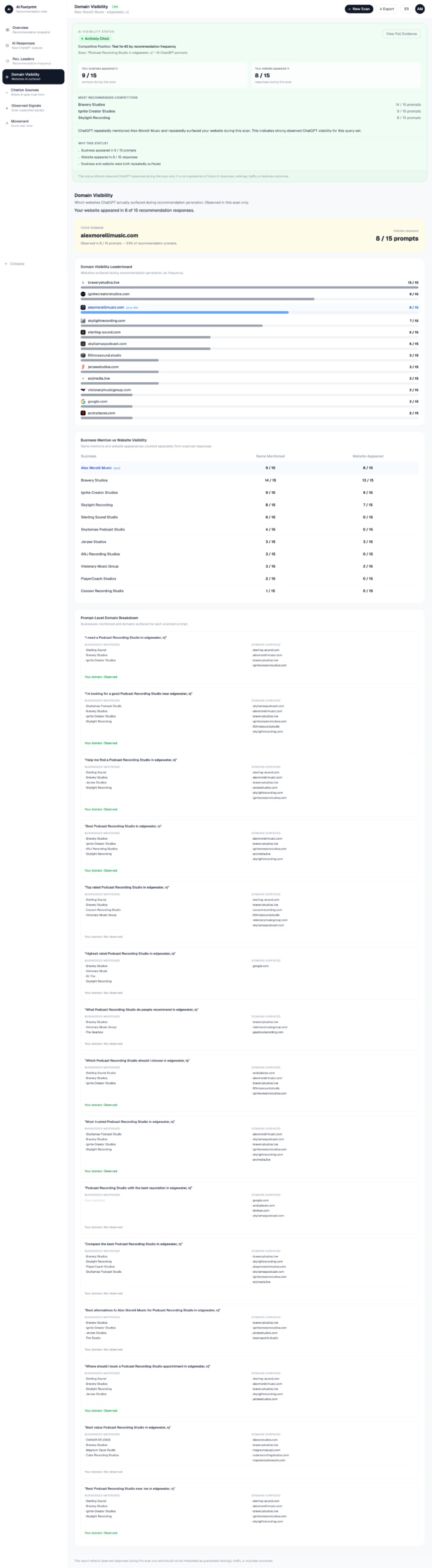
What You Can See Inside the AI Visibility Tool
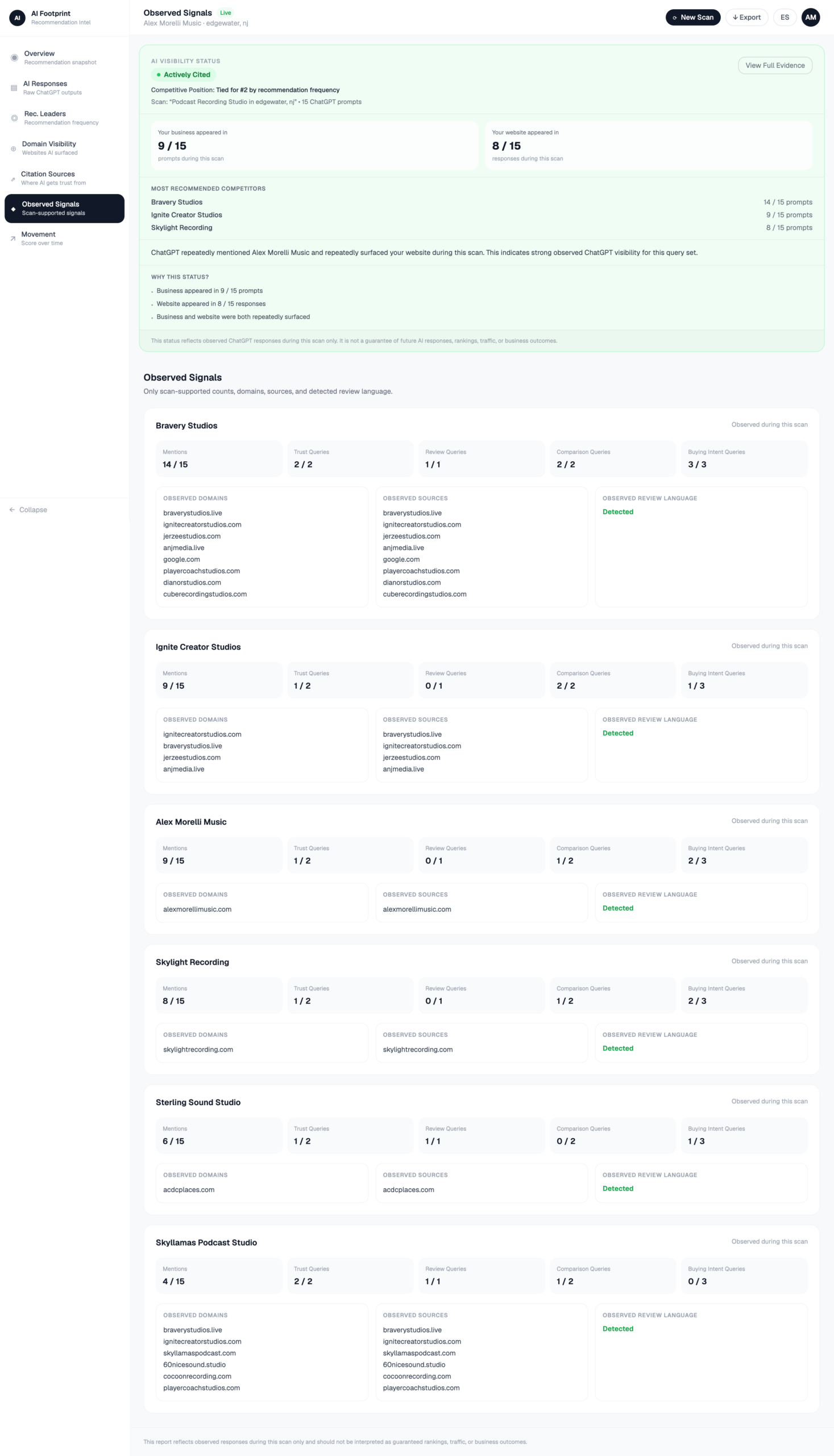
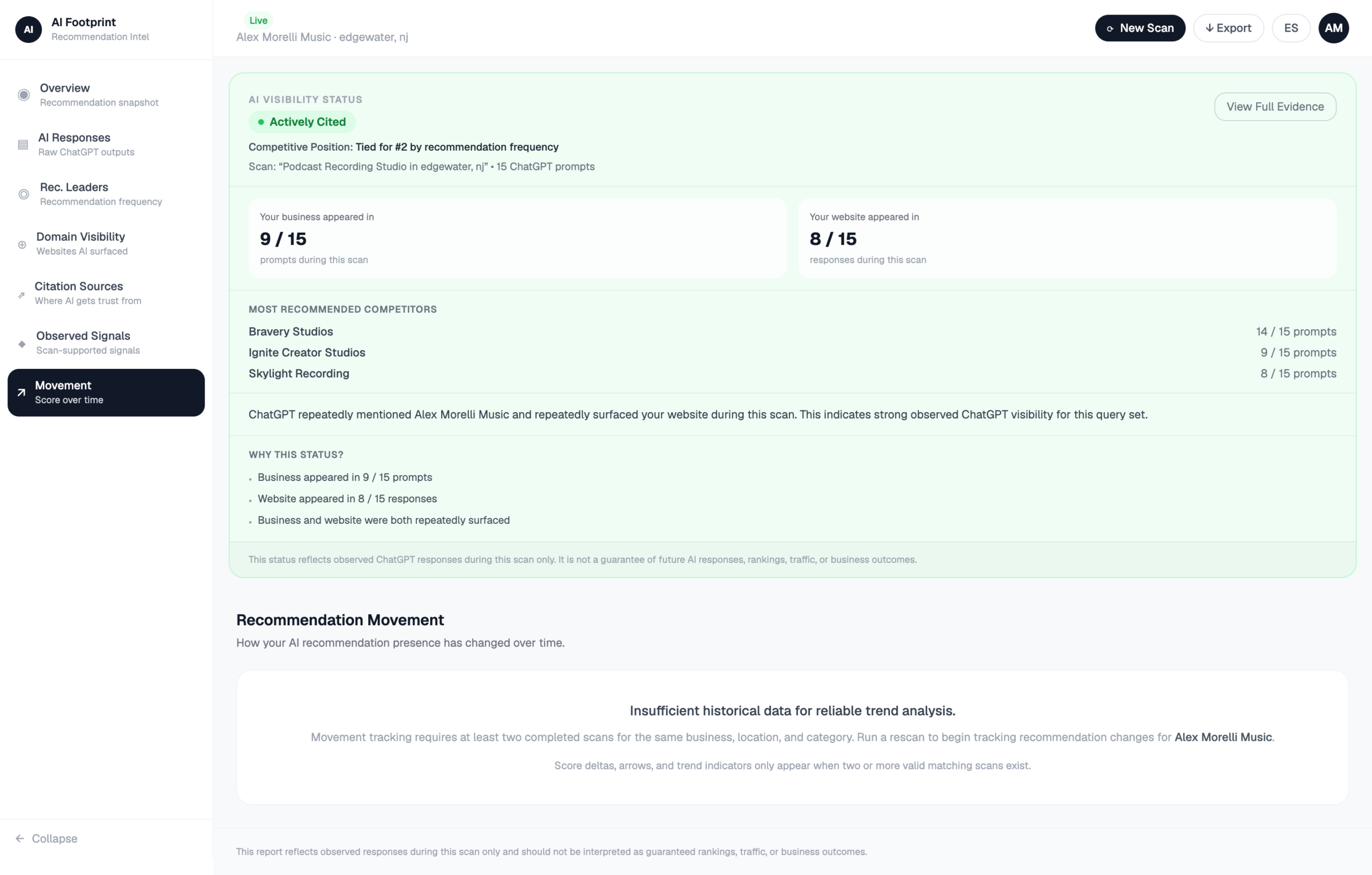
The report is where the tool turns raw AI responses into readable visibility intelligence. It’s not a score or a grade. It’s a structured view of what AI systems said about your market during the scan period. Concrete counts. Actual responses. No interpretive layer between you and the data.
AI Visibility Tool vs Traditional SEO Tools
A rank tracker tells you where your website shows up in Google. It’s a good tool for what it measures.
It doesn’t measure what AI systems say when someone skips Google and asks ChatGPT for a recommendation instead. That’s a different question and it needs a different tool.
AskZenna isn’t a replacement for SEO software. It’s what you use when you want to see the channel your current tools can’t see.
| Dimension | Traditional SEO Tool | AskZenna AI Visibility Tool |
|---|---|---|
| Best for | Tracking rankings, keywords, backlinks, and search traffic. | Tracking how AI systems recommend, mention, and cite businesses inside generated answers. |
| Channel | Search engine results pages | AI-generated recommendation responses |
| Data source | Crawl data, keyword data, link data | Observed AI responses collected during the scan |
| Output | Rankings, keyword positions, backlink counts | Business mentions, competitor appearances, domain citations |
| Competitor view | Keyword overlap and ranking gaps | Which competitors AI recommended and how often |
| Scoring | Traffic estimates, difficulty scores, DA | Direct response counts. No estimates. No scores. |
| Blind spot | Cannot show what ChatGPT or AI systems say in recommendation answers. | Does not replace technical SEO, rank tracking, or backlink analysis. |
Both tools answer valid questions. They just answer different ones.
Built for AI Visibility, GEO, AEO, LLM Visibility, and AI Search
Some marketers call this Generative Engine Optimization, or GEO. Others call it Answer Engine Optimization, AEO, or LLMO. Some agencies are pitching it as AI search optimization or AI Overview optimization. The labels keep multiplying.
AskZenna uses the simpler term AI visibility because the business question is direct: when AI answers a customer in your category, does your business appear? That’s the question. Everything else is terminology.
Whether your team calls it GEO, AEO, LLM visibility, or AI search visibility, the platform works the same way. It runs real prompts, collects observed responses, and shows you what came back. If you’re evaluating any strategy related to generative AI, AI Overviews, or LLM recommendation presence, the scan is the starting point. You need baseline data before anything else makes sense.
Who Uses an AI Visibility Tool?
Any business where customers ask AI for recommendations before making a decision. Local businesses, multi-location companies, agencies managing client markets. If people in your category are asking AI which business to hire or which product to buy, there’s something worth tracking.
If people ask AI for a recommendation in your category, there’s something to track.
Based on Responses. Not Estimates.
Every metric in an AskZenna AI visibility report comes directly from responses collected during the scan. There’s no modeling layer on top. No algorithm that infers what AI probably thinks. The data is what came back.
Observed Signals show direct counts from those responses. If a business appeared in seven answers, the report says seven. If it didn’t appear at all, the report says that instead. Movement data, when it appears, only shows up after two matching scans exist for the same market.
No projected visibility scores. No simulated results. No estimates.
AI answers change over time and vary based on how questions are phrased and which system answers them. Every scan is a point-in-time view of observed responses. That’s a feature, not a limitation. You’re looking at what AI actually said, not what a model predicts it might say.
Why I Built This
I wanted to know whether AI systems were recommending my businesses or someone else’s.
SEO tools showed me rankings. Analytics showed me traffic. But nothing showed me what AI was saying when someone asked for a recommendation in my market.
AskZenna started as a way to answer that question. It’s now an AI visibility platform that businesses and agencies use to understand how AI systems describe, recommend, and cite businesses inside the answers they generate.
That is why AskZenna exists: to make AI recommendations, citations, and competitor visibility measurable.
Track Who AI Recommends
In Your Market
Your current marketing stack doesn’t show what AI systems are saying about your business. AskZenna does.
Common Questions
An AI visibility tool tracks how AI systems mention, recommend, compare, and cite businesses inside generated answers. It runs targeted prompts through AI systems and records what comes back: which businesses were named, which websites were cited, how often competitors appeared, and which question types triggered recommendations.
AskZenna collects those observed responses and delivers a structured report showing what the scan found. No estimates. No modeling. What AI said is what the report reflects.
AskZenna submits a set of targeted questions to AI systems covering your market category and location. The responses are collected, parsed, and structured into a report showing which businesses appeared, how often, in what context, and with which websites cited.
The process is straightforward: prompts go in, real AI responses come back, and the tool turns those responses into readable data. There’s no scoring model on top and no simulated output.
AskZenna tracks six things across every scan: business mention counts, competitor recommendation frequency, website and domain citations, prompt-level visibility by question type, AI response patterns across the market, and visibility movement over time when multiple scans exist.
Business name appearances and domain citations are counted separately because they often tell a different story.
They refer to overlapping ideas. Generative Engine Optimization (GEO), Answer Engine Optimization (AEO), and LLM visibility optimization (LLMO) are all terms for strategies related to how businesses appear in AI-generated answers.
AskZenna uses “AI visibility” because the question it answers is simple: when AI answers a customer in your category, does your business appear? The scan gives you the baseline data that any GEO, AEO, or LLMO strategy would need to start from.
SEO software measures keyword rankings, organic traffic, backlinks, and performance in search engine results. AskZenna measures AI-generated recommendation mentions, competitor appearances, and domain citations inside observed AI answers.
They’re not substitutes for each other. They measure different channels. If someone skips Google and asks ChatGPT for a business recommendation, a rank tracker won’t capture that. This does.
Yes, based on collected responses during the scan. The report shows whether your business appeared in ChatGPT answers and how many times across the prompt set. It also shows which competitors appeared and how often.
AskZenna doesn’t control what ChatGPT says and can’t guarantee any specific result. What it can do is show you what came back from the prompts that were run.
Yes. Competitor tracking is a core part of what the AI visibility tool does. Every scan shows which businesses AI named, how often each appeared, which prompts triggered competitor mentions, and how their citation counts compare to yours.
That’s often the most useful part of the report: not just knowing where you stand, but seeing who AI is surfacing instead of you and how concentrated that recommendation pattern is.
Yes. Agencies use AskZenna to run AI visibility audits for client markets, benchmark how clients appear against competitors inside AI-generated answers, and add AI recommendation analysis to their reporting.
If you’re running scans across multiple clients, mention that context when you request a scan and we’ll work through it with you.
The AI visibility tool runs against real responses from your market. You’ll see exactly what came back.
Request Your Free AI Visibility ScanNo software to install. Scan requests reviewed before delivery.
AskZenna AI visibility reports reflect observed AI responses collected during the scan period. AI outputs vary based on how questions are phrased, when they’re asked, and which AI system answers them. Results represent a point-in-time view only. AskZenna does not control, influence, or guarantee the outputs of any AI system. No metric in any AskZenna report is estimated, simulated, or projected.